
- Home
- Crypto Blog
- How Digital PR Can Support Blockchain Brand Authority
How Digital PR Can Support Blockchain Brand Authority
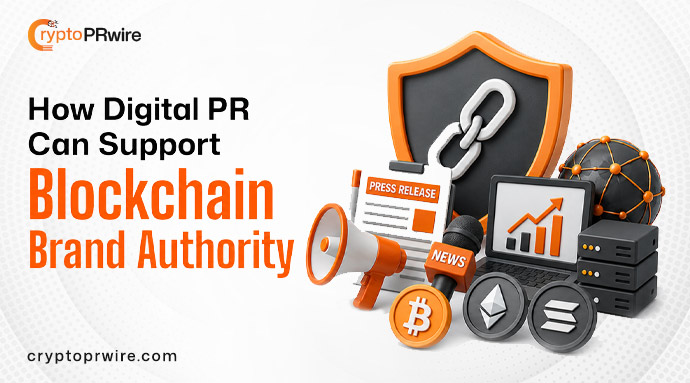
Digital PR is becoming more important for blockchain companies as the crypto sector competes for trust, media attention and visibility across search engines and AI platforms.
That matters today because crypto remains a large but high-risk financial market. CoinMarketCap recently showed the global crypto market at roughly $2.18 trillion, with about $54.38 billion in 24-hour trading volume.
At the same time, security incidents, misleading promotions and regulatory scrutiny mean that blockchain brand authority cannot be built through visibility alone. Projects increasingly need evidence, transparent communication and independent references.
Crypto Market Data Shows Why Reputation Still Matters
The size of the digital asset market makes credibility important for exchanges, protocols, wallets, DeFi platforms and other Web3 businesses.
Crypto Market Context
Metric | Latest observed data |
Global crypto market cap | ~$2.18 trillion |
24-hour crypto volume | ~$54.38 billion |
Bitcoin price | ~$69,438 |
Bitcoin market cap | ~$1.39 trillion |
Bitcoin 24h volume | ~$52.18 billion |
Ethereum price | ~$2,249 |
Ethereum market cap | ~$271.43 billion |
Ethereum 24h volume | ~$33.55 billion |
Market figures are snapshots and can change quickly. CoinMarketCap's live Bitcoin and Ethereum pages supplied the individual asset data.
High trading volume can attract investors, developers and media attention. However, it can also attract scams, false claims and opportunistic promotions.
Chainalysis reported that addresses already identified as illicit received about $40.9 billion during 2024, equal to around 0.14% of measured on-chain transaction volume. The company warned that the figure could rise as more illicit addresses are identified.
That environment makes reputation an operating issue rather than simply a marketing goal.
How Digital PR Builds Blockchain Brand Authority
Digital PR can help a blockchain company create a public record that journalists, users, investors and search systems can independently review.
A strong campaign may connect company announcements with:
named executives and expert commentary;
verifiable on-chain statistics;
audit reports and security information;
regulatory disclosures;
product usage data;
partnerships that can be independently confirmed;
research reports;
transparent token or staking information.
The important factor is verification.
A press release claiming that a blockchain has “industry-leading adoption” offers limited value without evidence. A release showing wallet activity, transaction data, methodology and an identifiable source gives journalists something they can check.
Google Puts Trust at the Center of E-E-A-T
Digital PR also overlaps with the way publishers build search authority.
Google's current people-first content guidance says its systems look for signals associated with experience, expertise, authoritativeness and trustworthiness. Google specifically notes that, among these concepts, “trust is most important.”
Google also encourages clear sourcing, identifiable authorship, original reporting and evidence of expertise.
For blockchain companies, this creates an important distinction.
Getting a company name mentioned on dozens of websites is not automatically the same as building authority. High-quality reporting, reliable citations and accurate company information can create stronger trust signals than mass publication of nearly identical promotional material.
Earned Media Can Create Third-Party Verification
One useful role of Digital PR is earning coverage from independent publications.
When journalists independently examine a blockchain project, they may verify information such as:
funding announcements
mainnet or testnet launches
exchange integrations
developer activity
validator growth
token supply changes
security audits
institutional partnerships
regulatory approvals.
This type of coverage can create a broader information footprint around a brand.
Editorial Analysis
A useful way to think about blockchain authority is to compare the evidence behind each type of PR asset.
PR asset | Possible authority signal | Main risk |
Independent news coverage | Third-party validation | Facts may face stronger scrutiny |
Original research | Expertise and citation value | Poor methodology can damage trust |
Executive commentary | Identifiable expertise | Unsupported predictions create risk |
Press release | Official source record | Overly promotional claims |
Security report | Technical transparency | Incomplete disclosure |
On-chain analysis | Verifiable evidence | Misleading interpretation |
Paid placement | Awareness | Must be disclosed correctly |
The pattern is clear: the closer a communication is to independently verifiable evidence, the more useful it can be for long-term reputation.
Digital PR Should Not Become a Backlink Scheme
There is also an important SEO risk.
Google says paid placements should normally use rel="sponsored" or nofollow. Its spam policies also warn against advertorials, guest posts and widely distributed press releases that use optimized links primarily to manipulate rankings.
Therefore, blockchain PR teams should not measure success only through the number of backlinks generated.
Better performance indicators can include:
quality of publications mentioning the company
branded search growth
journalist citations
executive quote placements
referral traffic
unlinked brand mentions
research citations
sentiment around the brand
accurate inclusion in AI-generated answers
organic links earned after publication.
Google itself says linking to reliable external sources can help establish trustworthiness when those links provide useful context for readers.
Crypto Regulation Makes Accurate PR More Important
Blockchain companies also face stricter communication standards than many normal technology brands.
For example, the UK's Financial Conduct Authority says crypto financial promotions must be “fair, clear and not misleading.” Its updated guidance covers communications involving qualifying cryptoassets and places particular focus on promotions that may create consumer harm.
The FCA's framework also includes measures such as risk warnings and restrictions around certain promotional incentives for crypto products marketed to UK consumers.
As a result, aggressive language about token prices, staking income, ETF effects or future investment returns can create both reputation and compliance risks.
A credible blockchain PR strategy should clearly separate:
confirmed facts from predictions;
company statements from independent findings;
historical results from future expectations;
token utility from investment claims;
paid media from independent editorial coverage.
Authority Requires More Than Positive Headlines
Digital PR can support blockchain brand authority, but it cannot manufacture genuine credibility.
Projects still need strong fundamentals.
A company may receive media coverage while users remain concerned about token concentration, whale activity, liquidity, security, governance or a lack of transparency.
PR teams should therefore work with technical, compliance and leadership teams before major campaigns begin.
For example, an announcement about staking should explain how staking works, where rewards come from and what risks users face. An announcement involving token supply should link to transparent supply or on-chain information where possible.
This approach makes the story easier for journalists to verify while reducing the risk of misleading users.
Expert View: Blockchain PR works best when communications become evidence that journalists and users can verify, not simply claims that a brand repeats about itself.
A Practical Blockchain Digital PR Strategy
Blockchain companies can structure Digital PR around five steps:
Identify a real story.
Focus on launches, partnerships, research, adoption data, security updates or measurable milestones.Build an evidence pack.
Include official documents, blockchain explorers, audit reports, statistics and named sources.Use qualified experts.
Give journalists access to founders, developers, researchers or compliance professionals who understand the subject.Disclose risks and commercial relationships.
Clearly identify sponsored content and avoid presenting speculation as fact.Measure authority instead of link volume.
Track meaningful media mentions, citations, branded searches, journalist relationships and referral traffic.
This approach may be slower than mass crypto press release distribution, but it is better aligned with the way trust is built in a YMYL sector such as crypto.
Digital PR and AI Search Visibility Are Converging
Search visibility is also changing.
Google's 2026 guidance for AI-powered search features recommends creating unique, useful and non-commodity content instead of simply reproducing information that already exists elsewhere. It highlights original viewpoints and first-hand expertise as useful qualities.
This creates another reason for blockchain brands to invest in original research, expert commentary and reliable documentation.
Digital PR can distribute those assets beyond a company's own website, creating more places where a brand and its expertise may be discovered.
However, no PR campaign can guarantee citations in Google, AI systems or other search products.
What Blockchain Brands Should Measure
A blockchain PR campaign should use a balanced scorecard rather than relying on one metric.
Useful indicators include:
authoritative media mentions
branded search demand
referral sessions
journalist response rates
share of voice
executive citations
independent backlinks
research references
correction requests
sentiment trends
conversion from earned media
citations across traditional and AI search platforms.
Teams should compare these metrics over several months.
A single major article may generate stronger brand authority than dozens of low-quality placements.
Outlook: Trust Is Becoming a Competitive Asset
Digital PR can support blockchain brand authority when it connects media visibility with evidence, expertise and transparent communication.
The potential reward is stronger recognition among users, journalists, developers and industry partners. However, poor PR can have the opposite effect. Unsupported price claims, hidden sponsorships, exaggerated adoption figures or misleading financial promotions can damage trust.
The most sustainable approach is therefore not to publish more claims. It is to make more claims verifiable.
As regulation expands and search systems place greater emphasis on useful, trustworthy information, blockchain companies that combine transparent data with credible media relations may be better positioned to build lasting authority.
Disclaimer: This article is for informational purposes only and is not financial advice. Please do your own research (DYOR) and consult a licensed financial advisor before investing.

Kartik Sharma is a content strategist and crypto PR writer specializing in blockchain, Web3, and digital marketing. With a passion for simplifying complex topics, he crafts SEO-driven content, press releases, and guides that help crypto startups gain visi