
- Home
- Crypto Blog
- How Crypto PR Agencies Can Track AI Search Visibility
How Crypto PR Agencies Can Track AI Search Visibility
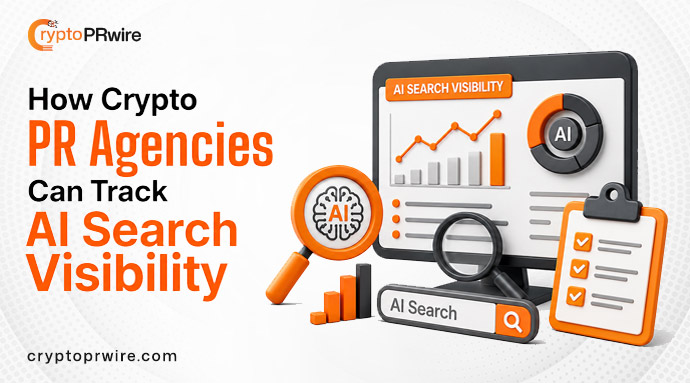
AI search visibility is becoming a measurable part of crypto public relations. Crypto PR agencies can no longer judge a campaign only by Google rankings, backlinks, publication count, or website traffic.
Today, brands may also appear as cited sources inside Google AI Overviews, Google AI Mode, ChatGPT Search, and other answer engines. The change matters for blockchain companies because users increasingly ask long questions about token launches, regulation, staking, exchanges, security, ETFs, and market trends instead of typing only short keywords.
Google gave publishers a major new measurement tool on June 3, 2026, when it announced dedicated generative-AI reports in Search Console. The reports can show visibility from AI Overviews, AI Mode, and generative features in Discover.
That makes AI search visibility less of an abstract PR idea and more of a metric agencies can begin putting into campaign reports.
Key AI Search Visibility Stats for PR Teams
Metric | Latest Available Information |
Google generative-AI reports | Announced June 3, 2026 |
Google AI report metrics | Impressions, pages, countries, devices and dates |
AI Overviews reach | More than 1.5 billion monthly users reported in 2025 |
AI training crawler share | 52% of crawler requests in Cloudflare's June 2026 data |
Mixed-use AI crawlers | More than 36% in Cloudflare's June 2026 data |
Google said AI Overviews had reached more than 1.5 billion monthly users across 200 countries and territories by May 2025. The company also reported more than 10% growth in Google usage for query types showing AI Overviews in major markets such as the U.S. and India.
Meanwhile, Cloudflare reported that 52% of identified crawler requests were related to AI training by June 2026, while more than 36% came from mixed-use crawlers.
These numbers do not prove that AI citations will drive sales or token demand. They do show why PR teams need measurement beyond classic organic rankings.
Agencies building this strategy can first review how AI search engines evaluate crypto press releases before setting campaign KPIs.
Google Now Gives Agencies Direct AI Visibility Data
The biggest measurement change in 2026 comes from Google Search Console.
Google's new generative-AI reports are designed to show how often a website appears within AI features. Available dimensions include:
Impressions: how often site URLs appeared in generative AI features
Pages: which URLs gained AI visibility
Countries: where visibility occurred
Devices: devices used when a website appeared in Search AI features
Dates: hourly, daily, weekly and monthly performance trends
However, agencies should note one important limit. Google said the dedicated reports were initially rolling out to a subset of websites, meaning access may not yet be uniform across every client property.
Google also says normal SEO fundamentals still apply to AI Overviews and AI Mode. A page must be indexed and eligible to appear with a Google Search snippet before it can appear as a supporting AI link.
Expert Source Note: Google states that there are “no additional requirements” for appearing in AI Overviews or AI Mode beyond its normal Search requirements.
For crypto PR teams, this means technical SEO, clear writing, factual sourcing, internal links and trustworthy media coverage remain important.
A useful supporting resource is this guide on creating crypto PR content AI search engines can cite.
How Agencies Can Measure ChatGPT Search Referrals
ChatGPT offers another useful tracking signal.
OpenAI says publishers that allow OAI-SearchBot can measure traffic from ChatGPT through analytics systems such as Google Analytics. ChatGPT automatically adds the parameter:
to referral URLs from its search results.
This allows an agency to create a GA4 report for ChatGPT sessions and monitor:
landing page
engaged sessions
engagement time
conversions
campaign page visits
returning users
referral growth over time
OpenAI also separates its search crawler from GPTBot. OAI-SearchBot supports discovery in ChatGPT Search, while GPTBot relates to content that may be used for model training. A site can therefore allow Search crawling while separately controlling GPTBot.
That distinction is important when a crypto publisher creates its crypto press release strategy, because blocking every AI crawler could reduce discovery opportunities.
Track Citations Instead of Traffic Alone
Referral traffic tells only part of the story.
An AI answer may cite a crypto company's announcement without creating a click. A user could read the answer, remember the company name, and later search for the brand directly.
For this reason, agencies should create a fixed prompt-testing set.
For example, a token-launch campaign could track queries such as:
“What is Project X?”
“Who developed Project X?”
“What blockchain does Project X use?”
“Has Project X completed an audit?”
“Where is Project X listed?”
“What are the risks of Project X?”
The prompts should be repeated on a fixed schedule across the same AI platforms.
Agencies can then calculate an AI Citation Share:
AI Citation Share = Brand citations ÷ total tested prompts × 100
If a company is cited in 18 of 50 monitored prompts, its measured citation share would be 36% for that test set.
This is an agency measurement method, not an official ranking factor from Google or OpenAI.
Build an AI Search Visibility Scorecard
A stronger report should combine several signals rather than relying on one metric.
1. Citation Presence
Record whether the client's website, newsroom, press release or third-party coverage appears as a source.
2. Cited URL Coverage
Track which pages receive citations. A campaign with 20 published stories but only one cited URL may have weak source diversity.
3. Brand Mention Rate
Measure how often the brand is named in responses even when no direct citation appears.
4. ChatGPT Referral Traffic
Use the OpenAI referral parameter and GA4 to track measurable visits from ChatGPT Search.
5. Google Generative Impressions
Where available, compare AI Overviews and AI Mode impressions before and after PR distribution using Search Console's generative-AI reports.
6. Branded Search Demand
Monitor whether searches for the company, founder, token, product or blockchain project rise after campaign publication.
7. Publisher Citation Rate
Compare which media outlets appear most often as supporting AI sources.
This can help a PR team refine future Web3 press release strategies based on measurable coverage rather than publication count alone.
AI Visibility Needs Source-Level Attribution
AI crawler activity should not be confused with successful PR performance.
Cloudflare reported crawler-to-referral ratios ranging from roughly 118:1 to nearly 50,000:1 for major AI crawlers around its 2025 Content Independence Day measurement period.
This shows why “AI bot visits increased” is not enough to prove campaign success.
Crawler activity, citations, referrals and conversions are different events.
A useful funnel is:
Crawl → Index or retrieval → Citation → Referral → Engagement → Conversion
PR agencies should measure each stage separately where data is available.
Why Crypto Brands Need Extra Care With AI Results
Crypto is a high-risk financial information category.
AI platforms can summarize information from different sources, while token details may change after a launch, listing, audit, funding round or regulatory update.
Agencies should therefore check whether answers correctly state:
token and project names
blockchain network
contract addresses
audit status
exchange listing details
funding claims
staking information
supply data
official team statements
An incorrect AI answer should not automatically be treated as a failure of the project's website. AI answers can vary between prompts, users, models and dates.
For this reason, repeatable testing matters more than a single screenshot.
Teams should also follow a factual crypto press release writing process so AI systems and human readers have clear primary information to evaluate.
What Crypto PR Agencies Should Report Monthly
A practical monthly AI-search report can contain five main groups:
Reporting Area | Suggested KPI |
AI citations | Citation share and cited URLs |
Google AI visibility | AI impressions and visible pages |
ChatGPT traffic | Sessions, engagement and conversions |
Brand demand | Branded query impressions and clicks |
Media performance | Publisher pickup and citation frequency |
The agency can also compare the results with classic SEO metrics such as organic clicks, backlinks and publication reach.
This avoids a common mistake: treating AI search as a replacement for SEO.
Google says the same foundational SEO practices remain relevant to AI features, including crawl access, internal linking, useful content, text availability and accurate structured data.
AI Search Visibility Is Useful, but Not Guaranteed
AI search creates another discovery channel for crypto and blockchain companies, but no PR agency can promise inclusion or citations.
Google explicitly says meeting its technical and content requirements does not guarantee that a page will be crawled, indexed or served.
Likewise, ChatGPT Search selects and presents sources based on the query and search process. OpenAI describes Search as providing timely answers with links to web sources, but appearing in a particular answer is not guaranteed.
The more useful goal is measurable progress.
A crypto PR agency can track whether citations increase, whether authoritative pages are referenced, whether AI referrals engage with the website, and whether branded demand grows over several campaigns.
That provides a more balanced picture of AI search visibility than rankings or traffic alone.
Disclaimer: This article is for informational purposes only and is not financial advice. Please do your own research (DYOR) and consult a licensed financial advisor before investing.

Kartik Sharma is a content strategist and crypto PR writer specializing in blockchain, Web3, and digital marketing. With a passion for simplifying complex topics, he crafts SEO-driven content, press releases, and guides that help crypto startups gain visi