
- Home
- Crypto Blog
- AI Citations or Google Rankings: What Matters for Crypto?
AI Citations or Google Rankings: What Matters for Crypto?
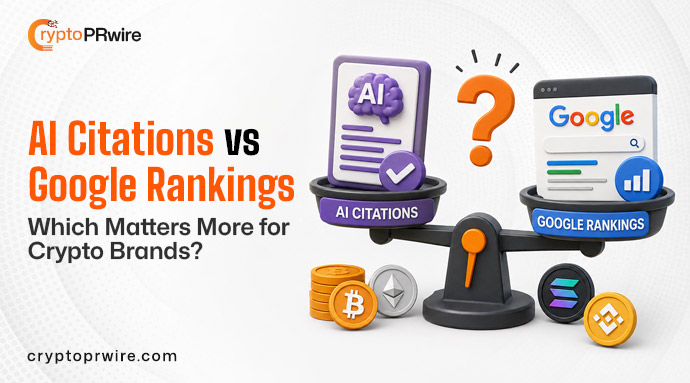
AI Citations are becoming a new measure of online visibility for crypto brands, but they have not replaced Google rankings.
That difference matters today because investors may discover information through Google AI Overviews, AI Mode, ChatGPT Search, traditional organic results, news feeds, or a mix of all five.
Google's latest guidance makes one point especially important: its generative AI search products still depend heavily on core Search systems and indexed web pages.
For crypto companies, therefore, the real question is not whether to choose AI search or traditional SEO. The stronger strategy is to build content that can rank, earn trust and become useful enough for AI systems to reference.
Crypto Market Context Makes Search Trust More Important
The crypto market remains large enough that inaccurate information can reach millions of readers quickly.
At the time of writing, CoinMarketCap reported a global cryptocurrency market capitalization of about $2.19 trillion and approximately $46.02 billion in 24-hour market volume. Bitcoin dominance stood near 58.81%.
Crypto Market Stats Box
| Metric | Latest Data |
| Global crypto market cap | $2.19 trillion |
| 24-hour crypto volume | $46.02 billion |
| Bitcoin dominance | 58.81% |
| DeFi 24-hour volume | $7.44 billion |
| Market data source | CoinMarketCap |
Figures are market snapshots and may change after publication.
These numbers explain why YMYL standards matter. A wrong statement about an altcoin, ETF, token listing, staking return, whale activity or blockchain regulation can affect financial decisions.
Crypto publishers should therefore treat source quality as part of both SEO and AI visibility.
AI Citations vs Google Rankings: The Core Difference
A Google ranking describes where a webpage appears for a search query.
An AI citation is different. It generally occurs when an AI-powered experience uses or presents a webpage as a supporting source for an answer.
OpenAI says ChatGPT Search can provide timely answers with links to relevant web sources.
Meanwhile, Google says AI Overviews and AI Mode surface supporting links and may run several related searches through a process it calls query fan-out.
That creates two different visibility opportunities.
Traditional search can deliver:
-
Organic rankings
-
Search impressions
-
Search clicks
-
Branded queries
-
Discover visibility
-
Google News traffic
AI search can deliver:
-
Source citations
-
Supporting links
-
Brand mentions
-
Discovery through complex questions
-
Visibility across related queries
The two channels overlap more than many marketers assume.
Why Google Rankings Still Matter More as a Foundation
For most crypto brands, Google rankings should still be treated as the foundation.
Google states that a page must be indexed and eligible to appear in normal Search with a snippet before it can qualify as a supporting link in AI Overviews or AI Mode.
That is a major clue.
A crypto press release site cannot simply ignore technical SEO and optimize only for AI Citations.
Google's 2026 generative AI optimization guidance also says its AI features are rooted in core Search ranking and quality systems. The company describes retrieval-augmented generation as relying on those systems to locate relevant and current pages.
Editorial Comparison
| Visibility Factor | Google Rankings | AI Citations |
| Requires crawlable content | Yes | Usually |
| Google indexing needed | Yes | Yes for Google AI features |
| Strong E-E-A-T useful | Yes | Yes |
| Original reporting useful | Yes | Yes |
| Can generate direct clicks | Yes | Yes |
| Easy to measure | Relatively | Improving |
| Long-term SEO value | High | Growing |
| Suitable as standalone strategy | Yes | Not yet |
Our analysis suggests that AI visibility currently works best as an extension of strong search visibility rather than a replacement for it.
AI Citations Still Create a Major New Opportunity
Rankings remain important, but dismissing AI search would also be a mistake.
Users increasingly ask complete questions instead of typing short keyword strings.
A person researching Bitcoin may ask:
-
Why did Bitcoin trading volume increase today?
-
What does ETF inflow mean for BTC?
-
Which blockchain has the highest staking ratio?
-
Is a new crypto presale audited?
-
What regulations apply to a particular exchange?
These queries naturally suit AI-generated answers.
Google says AI Mode is designed for nuanced questions, comparisons and subjects that may previously have required several separate searches.
As a result, a crypto press release publisher that answers precise questions with evidence may become visible for topics beyond one primary keyword.
Google Can Now Track Some Generative AI Visibility
Measurement has also started to improve.
On June 3, 2026, Google announced dedicated Search Generative AI performance reports in Search Console for a subset of websites. The reports can show impressions, pages, countries, devices and performance over time for Google's generative AI features.
This matters because marketers have traditionally measured SEO through:
-
Rankings
-
Impressions
-
Click-through rates
-
Organic sessions
-
Conversions
AI visibility adds another layer.
Crypto brands can increasingly study whether important research pages, news reports and token analysis pages are appearing inside generative search experiences.
What Makes Crypto Content More Citation-Worthy?
There is no verified shortcut that guarantees an AI citation.
Google specifically warns publishers against treating generative search optimization as a collection of special hacks. Its current guidance says normal SEO practices remain relevant.
Publish Facts That Can Be Checked
Crypto articles should separate confirmed data from promotional statements.
For example, instead of writing:
A project is becoming the next major blockchain.
A stronger newsroom approach would explain:
-
Token contract address
-
Network used
-
Market cap
-
Circulating supply
-
Trading volume
-
Audit provider
-
Exchange announcement
-
On-chain wallet activity
-
Team disclosures
-
Regulatory information
Each important claim should point to an original or authoritative source.
Add Information Others Do Not Have
Google's latest AI guidance places particular emphasis on unique, valuable and non-commodity content rather than simply rewriting information already available online.
Crypto publishers can add original value with:
-
Tokenomics analysis
-
On-chain observations
-
Smart-contract checks
-
Historical price comparisons
-
Exchange-liquidity comparisons
-
Original interviews
-
Regulatory document analysis
-
Risk tables
-
Project-claim verification
This improves usefulness for human readers while also creating clearer information that search systems can evaluate.
What Should Crypto Brands Prioritize in 2026?
A practical strategy is not AI Citations versus SEO.
It is SEO first, citation readiness alongside it.
Priority 1: Technical Search Visibility
Make sure important pages are:
-
Crawlable
-
Indexable
-
Canonicalized correctly
-
Fast on mobile
-
Internally linked
-
Free from major duplication
-
Supported by descriptive titles
Google confirms that technical eligibility remains necessary for visibility in its generative search products.
Priority 2: Source-Level Trust
Every financial claim should be traceable.
For example:
-
Price claim: use reliable market data.
-
Exchange listing: use the exchange announcement.
-
Token supply: check the blockchain explorer or project contract.
-
ETF information: use the issuer or regulatory filing.
-
Regulation: cite the relevant government or regulator.
This approach reduces YMYL risk and improves reader trust.
Priority 3: Clear Entity Information
AI systems and search engines need to understand who published the information.
Crypto publishers should clearly display:
-
Author name
-
Author bio
-
Publisher name
-
Editorial policy
-
Contact information
-
Publication date
-
Modification date
-
Sources
-
Corrections policy
These elements do not guarantee rankings or citations, but they make accountability easier for readers to evaluate.
Should Brands Stop Tracking Keyword Rankings?
No.
Keyword rankings still reveal how well pages compete in standard Search.
However, rankings should no longer be the only KPI.
A modern crypto visibility dashboard should track:
-
Organic impressions
-
Organic clicks
-
Average position
-
Branded search demand
-
Google News visibility
-
Discover traffic
-
AI-feature impressions where available
-
Referral traffic from AI platforms
-
Pages receiving AI visibility
-
Conversion or engagement quality
Google's new generative AI reporting tools make this combined approach increasingly practical.
AI Search Does Not Remove the Need for SEO
One of the clearest findings from Google's 2026 guidance is that publishers do not need a separate set of unusual technical tricks for AI search.
Google says there are no additional technical requirements to appear in AI Overviews or AI Mode beyond the relevant Search requirements.
It also says special files such as llms.txt do not improve Google Search rankings or generative AI visibility.
That makes the best strategy surprisingly familiar:
Create accurate content. Add original reporting. Cite primary sources. Maintain technical SEO. Update stale information. Make important facts easy for readers to verify.
Balanced Outlook: Which One Matters More?
For crypto brands in 2026, Google rankings matter more as the infrastructure, while AI Citations matter more as an emerging distribution opportunity.
It is risky to build a strategy around citations alone because AI answers, source selection and interfaces can change.
However, relying only on traditional blue-link rankings may also limit future reach as search becomes more conversational.
The strongest crypto brands should therefore optimize once for quality and distribute that authority across both environments.
Search rankings help users discover the page.
AI Citations may help the information travel further.
The common requirement is trustworthy, original and technically accessible content.
Disclaimer:
This article is for informational purposes only and is not financial advice. Please do your own research (DYOR) and consult a licensed financial advisor before investing.

Kartik Sharma is a content strategist and crypto PR writer specializing in blockchain, Web3, and digital marketing. With a passion for simplifying complex topics, he crafts SEO-driven content, press releases, and guides that help crypto startups gain visi