
- Home
- Crypto Blog
- Direct Outreach vs Crypto Press Release Distribution
Direct Outreach vs Crypto Press Release Distribution
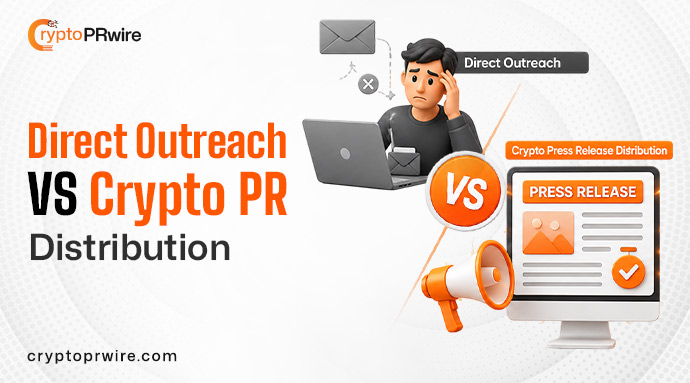
Crypto companies trying to announce an exchange listing, funding round, blockchain upgrade or new product increasingly face the same question: should they contact journalists one by one or use crypto press release distribution to push the announcement across multiple publications?
The answer is rarely one or the other.
Direct outreach can create deeper editorial relationships and more customized coverage. Distribution, meanwhile, can place the same verified announcement in front of a much larger media network within a short period.
Current distribution infrastructure shows how large that difference in scale can become. PR Newswire says its network reaches more than 500,000 media outlets, newsrooms and influencers worldwide, while its distribution service also reports access to hundreds of thousands of journalists and thousands of digital outlets.
For blockchain companies operating in a crowded and highly scrutinized sector, the better strategy often depends on the announcement, budget and desired type of coverage.
Direct Outreach Gives Crypto Teams More Editorial Control
Direct outreach means approaching selected journalists, editors, analysts or publications with a tailored story pitch instead of automatically sending the same release across a distribution network.
The process normally starts with research.
A Web3 communications team may examine what a journalist has recently covered, identify the publication's audience and then explain why its announcement is relevant to that specific beat.
For example, an exchange infrastructure announcement could be pitched differently to:
a crypto-market reporter
a fintech journalist
a cybersecurity publication
an institutional finance reporter
or a blockchain developer publication.
This makes direct outreach more precise.
However, it also requires significantly more manual work.
CryptoPRWire's guide to pitching crypto journalists recommends narrowing outreach to journalists whose recent coverage shows clear interest in the project's category rather than broadcasting the same message to hundreds of contacts.
Direct Outreach Is About Relevance, Not Volume
A list of 500 email addresses is not automatically more useful than a list of 10 highly relevant journalists.
An editor covering Bitcoin mining, for example, may have little interest in a generic NFT marketplace announcement.
Meanwhile, a journalist who has recently covered staking regulation, blockchain infrastructure or institutional adoption may be highly relevant to an announcement supported by strong data.
Projects should therefore provide verifiable information such as:
funding amount
transaction or user data
token supply
trading volume where relevant
market-cap figures from reliable sources
blockchain explorer data
audited smart-contract information
regulatory filings
named executives
and supporting technical documents.
The stronger the evidence, the easier it becomes for an editor to assess the story independently.
Crypto Press Release Distribution Prioritizes Scale
Crypto press release distribution solves a different problem: getting one standardized announcement into a broad media ecosystem quickly.
Distribution platforms can target geographic markets, industries and specialist media categories. PR Newswire, for example, says releases can be targeted by country, region, industry, vertical and media beat while providing campaign reporting after distribution.
That makes the model useful for time-sensitive announcements such as:
token generation events
blockchain mainnet launches
funding announcements
exchange listings
ecosystem partnerships
protocol upgrades
corporate appointments
and major product releases.
Distribution also creates a consistent public record.
Instead of explaining the announcement differently in dozens of individual messages, a company can publish one approved version containing its official claims, quotes, links and disclosures.
Distribution Does Not Equal Independent Coverage
This distinction is critical.
A syndicated press release and an independently reported editorial story are not the same product.
Distribution may guarantee delivery or contracted publication under specific package terms, but it cannot guarantee that an independent journalist will investigate the announcement or write a separate story.
Projects should therefore avoid describing syndicated placements as organic editorial endorsements.
Google's spam policies are also relevant here. Google explicitly identifies paid articles, advertorials and press releases containing links that pass ranking credit as potential link-spam issues when they are created primarily for ranking purposes.
Google recommends qualifying commercial links appropriately, with rel="sponsored" preferred for paid links and nofollow also supported.
SEO observation: Google says links can be valuable when they are “well deserved.”
Therefore, crypto PR should be designed around legitimate communication and audience reach rather than mass backlink creation.
Crypto PR Strategy Stats Box
Metric | Direct Outreach | Press Release Distribution |
Primary objective | Earn editorial interest | Scale announcement visibility |
Targeting | Very high | Broad to highly targeted |
Personalization | High | Limited after release approval |
Speed | Depends on journalist response | Often rapid after approval |
Relationship building | Strong | Limited |
Syndication potential | Low unless story is picked up | High |
Publication certainty | Usually none | Depends on package terms |
Independent editorial coverage | Possible | Not automatically included |
Measurement | Replies, stories, referrals | Placements, impressions, clicks |
Best use | Exclusive or complex story | Major public announcement |
For wider context, PR Newswire currently markets distribution reaching 400,000+ media outlets, newsrooms and influencers globally. Its more detailed distribution page lists 270,000+ journalist inboxes and 9,000+ digital media outlets.
Crypto-focused pricing also varies substantially. CryptoPRWire's published pricing guide describes standard multi-outlet packages of roughly $200 to $1,500, while broader premium campaigns can move above that range depending on media selection and services. Actual prices and outlet availability can change and should be verified before purchase.
Cost Changes the Direct Outreach vs Distribution Decision
Cost cannot be compared only by looking at the fee paid to a distribution service.
Direct outreach may have no distribution charge, but it carries an internal cost.
Someone has to:
research publications
identify journalists
read their recent coverage
prepare personalized pitches
answer follow-up questions
provide documentation
coordinate interviews
and track resulting stories.
For a founder-led startup, that time may be significant.
Distribution converts part of that work into a standardized workflow. The team prepares one approved announcement and selects a package or media network.
The trade-off is personalization.
A release about a DeFi staking product cannot explain a different angle to every reporter in the same way that individual outreach can.
Measurement Should Go Beyond Published Link Counts
Crypto brands should also rethink how they measure a PR campaign.
Counting backlinks alone gives an incomplete picture.
A more useful measurement model includes:
relevant media placements
referral traffic
branded search growth
journalist replies
social engagement
newsletter pickup
direct traffic
qualified partner inquiries
investor-relations page visits
and subsequent independent coverage.
PR Newswire itself promotes measurement around impressions, site postings and campaign analytics rather than treating distribution solely as a link-building product.
Its guidance also describes the first 24 to 48 hours after distribution as an important window for extending a release through owned, social and other channels.
Market Data Should Be Used Only When Relevant
Crypto announcements sometimes include market cap, price, trading volume or token activity.
Those figures can strengthen a story when they are relevant and independently verifiable.
However, projects should avoid inserting unrelated market numbers merely to make a release appear more important.
For example, an exchange-listing announcement may reasonably include:
trading pair
deposit opening time
trading start time
token contract
circulating supply
verified market price
and 24-hour trading volume.
A blockchain developer-tool launch may have no reason to discuss token resistance, support levels, ETF activity or whale transactions at all.
Relevance improves credibility.
The Strongest Model Combines Distribution and Outreach
In practice, the comparison does not need to end with one winner.
A hybrid strategy can use both channels for different purposes.
First, the company prepares an accurate press release containing its verified announcement.
Then it distributes that announcement to create broad visibility and an accessible public reference.
At the same time, the communications team can send customized pitches to a small number of journalists who are particularly relevant to the story.
CryptoPRWire's own writing guidance similarly suggests combining distribution with a limited number of targeted journalist pitches for many early-stage projects rather than treating the two methods as mutually exclusive.
A Hybrid Campaign Could Look Like This
Stage 1: Prepare evidence
Collect the announcement, official documentation, executive quotes, blockchain data and regulatory information.
Stage 2: Publish the release
Use an appropriate distribution network based on geography, audience and budget.
Stage 3: Contact priority journalists
Pitch a different angle, exclusive interview or additional dataset.
Stage 4: Amplify through owned channels
Publish the announcement through the company's website, X account, LinkedIn, newsletter and community channels.
Stage 5: Measure outcomes
Separate paid or syndicated placements from earned editorial stories.
This distinction makes reporting more transparent.
Google News Visibility Requires More Than Distribution
Crypto companies should also be cautious about claims that paying for distribution automatically guarantees Google News exposure.
Google states that Article structured data can help its systems understand a news page and information such as the headline, author, images and publication date. However, Article markup itself is not a requirement for appearing in Google News features such as Top Stories.
Google also recommends showing a clear visible publication date and keeping that date consistent with datePublished and dateModified structured-data values.
Therefore, distribution should be viewed as one component of a broader publishing strategy.
Strong original reporting, transparent authorship, source attribution and useful information remain more important than simply increasing the number of syndicated URLs.
Direct Outreach vs Crypto Press Release Distribution: Which Wins?
Neither channel wins in every situation.
Direct outreach is stronger when:
the story requires explanation,
an exclusive matters,
the announcement contains original research,
journalist relationships are a priority,
or the target publication is highly specific.
Crypto press release distribution is stronger when:
timing is important,
the announcement must reach many outlets,
several geographic markets are involved,
the company needs consistent messaging,
or scalable reporting is required.
For many Web3 companies, the most practical approach is a combination.
Distribution creates breadth. Direct outreach creates depth.
The important point is to separate syndicated visibility from earned journalism, measure both independently and support every crypto-related claim with verifiable evidence.
That approach may not produce instant editorial attention, but it creates a more credible communications system for exchanges, blockchain companies, token projects and other Web3 businesses operating under increasing regulatory and media scrutiny.

Kartik Sharma is a content strategist and crypto PR writer specializing in blockchain, Web3, and digital marketing. With a passion for simplifying complex topics, he crafts SEO-driven content, press releases, and guides that help crypto startups gain visi