
- Home
- Crypto Blog
- How to Write Quotes That Journalists Actually Use
How to Write Quotes That Journalists Actually Use
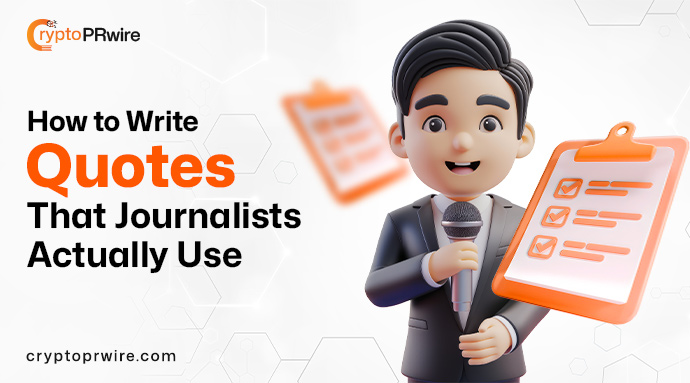
The quote in a crypto press release is one of the most misunderstood elements of the format. Most are written as if their purpose is to express enthusiasm about the announcement. Their actual purpose is to give journalists a line of direct attribution they can lift into a story without paraphrasing.
Understanding this distinction transforms how you write quotes and dramatically increases the chance that your words appear in coverage rather than getting silently replaced by a journalist's interpretation.
Why Journalists Use Quotes (And Why They Skip Yours)
When a journalist publishes a story, direct quotes serve a specific function: they add a human voice, provide attributable claims, and demonstrate that the subject of the story spoke for themselves. A quote in a published story is not decoration, it's evidence.
Because of this function, journalists are selective about which quote they use. They look for quote that:
Say something specific that the journalist can't paraphrase without losing meaning
Contain a claim or opinion that benefits from direct attribution
Sound like a real person, not a corporate press release
Add context or perspective beyond what the dry facts convey
They skip quotes that:
Express generic enthusiasm ("We are thrilled and honored to announce...")
Repeat information already in the press release body
Are filled with jargon that requires explanation
Sound like they were written by a committee
The test for any press release quote is simple: could a journalist replace it with "The company expressed enthusiasm about the launch" and lose nothing substantive? If yes, the quote isn't working.
The Anatomy of a Strong Crypto Press Release Quote
A quote that journalists will use contains:
A specific claim or perspective : something the speaker knows that isn't obvious from the announcement alone.
Direct attribution : it sounds like a real person who has direct knowledge, using first person.
Added context or implication : it explains what the announcement means, not just what it is.
Optionally: a data point or comparison : numbers in quotes are particularly powerful because they're attributable to the speaker.
Examples Side by Side
Weak quote (will not be used): "We are incredibly proud and excited to bring this revolutionary solution to the DeFi ecosystem. Our team has worked tirelessly to deliver this milestone, and we look forward to the incredible impact it will have on our community and the broader blockchain space."
Why it fails: Generic, no specific information, sounds like marketing copy, no journalist can extract anything specific.
Strong quote (will be used): "Most DeFi lending protocols require 150% collateral to borrow. We've proven that 110% is achievable without increasing liquidation risk and our 90-day backtests across three market cycles confirm it."
Why it works: Contains a specific claim (110% collateral), a specific comparison (vs. 150%), and specific evidence (90-day backtests, three market cycles). A journalist can lift this directly.
How to Interview Your Founder for Quotes
The best quotes come from real conversations, not writing by committee. Before drafting a press release, schedule a thirty-minute conversation with the founder or relevant spokesperson using these prompts:
"What would someone misunderstand about this announcement if they only read the headline?"
"What are you most surprised that you were able to achieve with this release?"
"What does this mean for the person who uses our product every day?"
"What were the biggest challenges you had to solve to get here?"
"What does this make possible that wasn't possible before?"
Record the conversation. The best quotes almost always emerge naturally from genuine answers, not from polished prepared statements. Edit for length and clarity, but preserve the speaker's natural voice and the specificity of their claims.
The CFO Quote vs The Founder Quote
Different types of announcements call for different speakers. Matching the quote to the appropriate voice strengthens the release's credibility:
Founder/CEO quotes work for: vision statements, product philosophy, community messages, and announcements with strategic significance.
CTO/Technical Lead quotes work for: product launches, security announcements, protocol upgrades, and anything where technical credibility is the primary trust signal.
Business Development/Partnerships quote work for: partnership announcements, exchange listings, and integrations where relationship narrative matters.
Community/DAO representative quote work for: governance announcements, community initiatives, and anything where the community voice adds legitimacy to a decision.
Using the right speaker for each announcement type makes each quote more credible and more likely to be used.
Multiple Quotes: When to Use Them
For major announcements particularly partnership press releases where both parties deserve a voice including two quotes is standard. This is particularly effective for token launches and exchange listing announcements, where a quote from the exchange listing team adds significant credibility beyond the project team's own statement.
For routine announcements, one strong quote is better than two mediocre ones. Never pad a release with additional quote to make it feel more substantial. Length is not quality.
Preparing Quotes for Different Audience Segments
The same announcement sometimes needs to be framed differently for different audiences. A DeFi protocol listing on a major CEX might warrant:
A technical quote for crypto-native media ("Our smart contract's gas optimization means transactions cost 73% less than the sector average")
A more accessible quote for mainstream fintech media ("For the first time, everyday investors can earn DeFi yields without managing private keys or understanding liquidity pools")
If you're pitching the same announcement to different tiers of media, consider including multiple quote and flagging to each journalist which quote is most appropriate for their audience.
What to Avoid in Crypto Founder Media Quotes
Regulatory red flags: Any quote that implies price appreciation, guaranteed returns, or investment promises creates legal exposure and will cause reputable journalists to reject your release entirely. Never include language like "investors can expect..." or "our token will..."
Unverifiable superlatives: "The most decentralized protocol," "the fastest blockchain," "the most innovative team" journalists won't include claims they can't verify, and these claims are never verifiable.
Excessive jargon: A quote dense with acronyms and technical terms requires a journalist to add explanation, which adds friction. If your quote needs a glossary, simplify it.
Passive voice: "It is believed that..." or "improvements have been made..." sound evasive. Direct quotes need direct voice.
The strongest quote in crypto PR are direct, specific, informative, and sound like a real person who believes in what they've built.

Kartik Sharma is a content strategist and crypto PR writer specializing in blockchain, Web3, and digital marketing. With a passion for simplifying complex topics, he crafts SEO-driven content, press releases, and guides that help crypto startups gain visi