
- Home
- Crypto Blog
- When to Issue a Press Release vs a Blogs Post in Web3
When to Issue a Press Release vs a Blogs Post in Web3
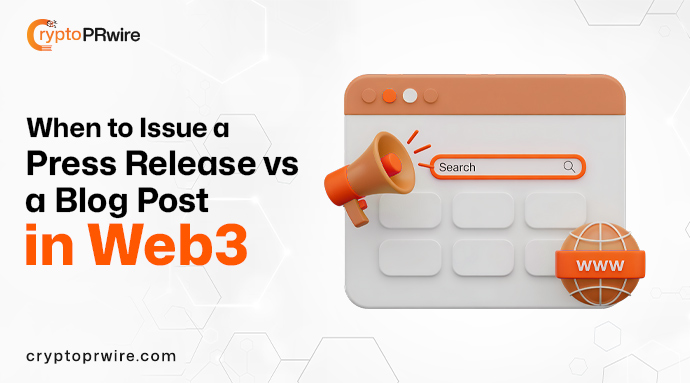
One of the most consistently confused decisions in Web3 content strategy is knowing when to issue a formal press release versus when to publish a blogs post. Teams default to one or the other based on habit, not strategy and this choice has real consequences for how content performs in media, search, and community channels.
The formats serve different audiences, travel through different distribution channels, and achieve different goals. Understanding when to use each is a fundamental skill for any blockchain communications team.
What Makes a Press Release Different
A press release is a news document formatted for journalists. Its structure headline, dateline, inverted pyramid body, boilerplate, contact information is designed to make it easy for a reporter to extract the key facts and write a story quickly. It is distributed through wire services and direct media outreach. It is intended to earn third-party coverage.
A press release's primary audience is not your community or your existing users. It's journalists, editors, and the readers of the outlets where those journalists publish.
What Makes a Blog Post Different
A blogs post is a long-form content piece published on your own site and distributed through your owned channels newsletter, social media, community platforms. It can be any length, adopt any tone, and explore any level of technical depth. Its primary audience is your existing community and potential users who find it through search.
A blogs post doesn't need to meet journalistic news standards. It doesn't need a dateline or a boilerplate. It can be opinionated, exploratory, or deeply technical in ways a press release can never be.
The Decision Framework
Ask these four questions before choosing your format:
1. Is this news?
News means something happened that is specific, verifiable, and recently occurred. If you can write a factual headline about it "Protocol Launches Feature X" or "Project Reaches Y Milestone" you probably have press release territory.
If your announcement is explanatory, educational, or perspective-driven "How We Think About Protocol Security" or "Why We Built Our Yield Model This Way" that's a blog post.
2. Would a journalist cover it?
Apply the journalist test: if you pitched this to a reporter at a Tier 1 crypto outlet, would they have a reason to write about it? If yes, it warrants a press release. If not, if the story is only interesting to your existing community it's a blog post.
3. Does it have a distribution channel beyond your owned audience?
Press releases travel through wire services, media pitches, and journalist relationships. They reach audiences that have never heard of your project. If your announcement has the potential to reach new audiences through media distribution, it warrants a press release.
Blog posts primarily reach your existing audience (with the exception of SEO-driven posts that rank for relevant search queries a significant value that deserves its own strategy).
4. What action do you want the reader to take?
Press releases generate awareness and media coverage. Blogs post generate direct community engagement, education, and search traffic. If your primary goal is earned media, write a press release. If your primary goal is educating your community or building search authority, write a blog post.
When to Use a Press Release
These events typically warrant a formal press release in Web3:
Mainnet or major product launches
Token generation events and presale announcements
Exchange listings (major CEXes and significant DEX listings)
Funding rounds and strategic investments
Significant partnership announcements with named organizations
Security audit completions
Protocol milestone announcements with verifiable metrics (TVL thresholds, user milestones)
Regulatory approvals or notable compliance achievements
Team additions of C-suite or advisory significance
The common thread: all of these are specific, verifiable events that journalists can report on independently.
When to Use a Blog Post
These situations call for a blog post instead:
Technical deep-dives explaining protocol architecture or design decisions
Founder perspective pieces and thought leadership
Community educational content about your token mechanics, governance, or roadmap
Response to market events or industry developments
Product update announcements for minor features or improvements
Documentation of community governance votes and outcomes
Post-mortems following incidents (with an exception noted below)
The Exception: Some Blog Posts Become Press Events
Certain blog post topics are compelling enough to pitch to the media even though the format is a post rather than a release. A detailed post-mortem after a security incident, a major technical research paper, or a comprehensive analysis of market trends can all generate earned media coverage when pitched properly.
In these cases, you write the blog post first, then craft a short press-style pitch around the most newsworthy element: "XYZ Protocol today published a detailed post-mortem following last week's $2M exploit, disclosing the root cause, affected addresses, and compensation plan."
The blog post is the full story. The pitch treats it as news.
Using Both in Tandem
The most sophisticated Web3 content strategy uses press releases and blog posts in tandem. When you have a major announcement:
Issue a press release for media distribution
Simultaneously publish a longer, richer blog post with the technical detail, founder commentary, and community context that a press release format can't contain
Distribute the press release through wire and journalist outreach
Distribute the blog post through newsletter, Discord, and Twitter
This approach serves both the media audience (through the press release) and the community/search audience (through the blog post), maximizing the total reach and value of every major announcement.
For a full framework on turning each press release into multiple content assets across formats, see How to Repurpose a Press Release into 10 Content Assets. And for guidance on making every format work harder for SEO, see How Press Releases Build Long-Term SEO Value for Web3.

Kartik Sharma is a content strategist and crypto PR writer specializing in blockchain, Web3, and digital marketing. With a passion for simplifying complex topics, he crafts SEO-driven content, press releases, and guides that help crypto startups gain visi