
- Home
- Crypto Blog
- How to Write a Boilerplate for Your Crypto Project
How to Write a Boilerplate for Your Crypto Project
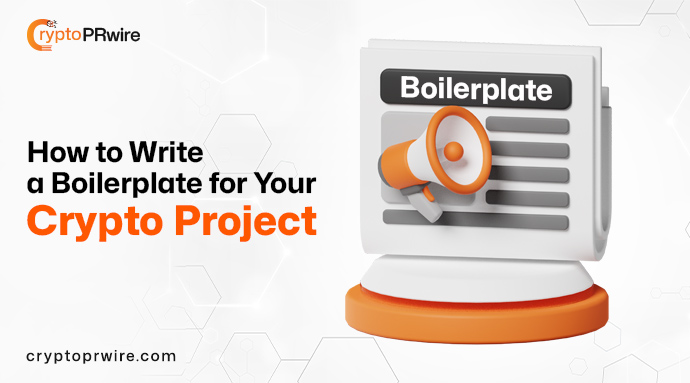
The boilerplate paragraph in the "About [Project Name]" section at the end of every press release is the most repeatedly published piece of writing your project will ever produce. It appears in every release you distribute, across every outlet that syndicates your content, and in every media kit you share with journalists, investors, and partners.
Given this ubiquity, it's remarkable how many crypto projects write their boilerplate as an afterthought and then never revisit it. A poorly written boilerplate creates a bad first impression every time your project appears in media coverage. A strong one builds recognition, credibility, and consistent positioning across every piece of coverage you earn.
What a Boilerplate Must Accomplish
The boilerplate has three jobs, and it must accomplish all three in five sentences or fewer:
1. Identify what the project is and what it does. A reader who has never heard of your project should understand in one or two sentences what category it belongs to and what function it performs. Not what it aspires to be, not what problem it's solving abstractly, but what it actually does for users right now.
2. Establish credibility signals. What evidence can you offer that this project is real, legitimate, and meaningful? This might be audit completions, notable investors, TVL figures, user count, chain information, or launch date. One or two specific, verifiable facts ground the boilerplate in reality.
3. Create a connection point. Where can interested readers learn more? A website URL is standard. Social media handles or a Discord link can be included if they're active and well-maintained.
The Structure of a Strong Boilerplate
A well-written crypto press release boilerplate follows this structure:
Sentence 1: What the project is and what it does. Subject, verb, object. No filler.
Sentence 2: What differentiates it or what makes it significant. This is where your one strongest claim goes.
Sentence 3: A credibility signal audit, investors, metrics, or chain information.
Sentence 4 (optional): Current status or milestone, if relevant.
Sentence 5: Where to learn more.
Examples: Weak vs. Strong Boilerplates
Weak boilerplate: "About XYZ Protocol: XYZ Protocol is an innovative next-generation DeFi platform that is revolutionizing the decentralized finance ecosystem by providing cutting-edge solutions for liquidity providers and traders.
Founded by a world-class team of blockchain veterans and financial experts, XYZ Protocol is committed to building the future of decentralized finance. Learn more at xyzprotocol.xyz."
Problems: Generic adjectives ("innovative," "next-generation," "cutting-edge"), no specific information, no credibility signals, no verifiable claims.
Strong boilerplate: "About XYZ Protocol: XYZ Protocol is a permissionless DeFi lending market on Ethereum that enables borrowers to access capital at 110% collateral ratios compared to the DeFi standard of 150%.
The protocol was audited by CertiK in April 2025 and currently holds $47M in total value locked across its lending pools. XYZ Protocol launched on Ethereum mainnet in March 2025 and is accessible at app.xyzprotocol.xyz."
This boilerplate tells a journalist or investor exactly what the project does, how it differentiates, that it's been audited, how large it is, and where to access it all in three sentences.
Common Boilerplate Mistakes in Web3
Using jargon that requires explanation. Your boilerplate will be read by journalists, investors, and general readers who may not know what "AMM," "TVL," or "ZK-rollup" means without context. If you must use technical terms, briefly define them on first use or replace them with plain-language equivalents.
Making claims that will become inaccurate. Boilerplates are published many times over months or years. If you include a specific TVL figure, it will be wrong within weeks. Use ranges ("over $40M"), milestones ("since reaching $50M TVL in Q1 2025"), or avoid specific metrics that change rapidly.
Changing it with every release. The boilerplate builds recognition through repetition. If you rewrite it for every press release, you lose the cumulative brand-building value of consistent positioning. Update it quarterly or when there is a significant change (new chain, new product, major milestone), not before every release.
Making it too long. A boilerplate that runs five or more sentences is too long. Journalists who include it in their coverage will truncate it. Keep it to three to four sentences and make each one count.
Updating Your Boilerplate
The boilerplate should be reviewed and potentially updated at these moments:
When your protocol launches on a new chain
When you reach a significant TVL or user milestone
When you complete a major audit or security certification
When you raise a significant funding round
When your core product offering changes meaningfully
Between these moments, keep it consistent. Consistency is the whole point.
The Boilerplate as Brand Infrastructure
The boilerplate is often underestimated because it's positioned at the end of the release where readers who aren't interested have already stopped.
But for journalists writing about your project months after initial coverage for investors researching you in due diligence for partners evaluating potential collaboration the boilerplate is often the first piece of official project description they read.
It deserves the same care and precision as any other element of your communications infrastructure. Get it right once, maintain it consistently, and let it do its quiet, essential work across every piece of coverage your project earns.

Kartik Sharma is a content strategist and crypto PR writer specializing in blockchain, Web3, and digital marketing. With a passion for simplifying complex topics, he crafts SEO-driven content, press releases, and guides that help crypto startups gain visi