
- Home
- Crypto Blog
- IDO vs ICO vs IEO: Which Launch Needs What Kind of PR?
IDO vs ICO vs IEO: Which Launch Needs What Kind of PR?
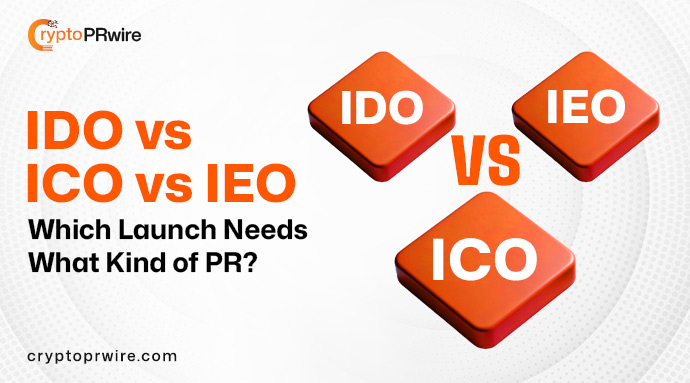
The launch model you choose changes more than your fundraising mechanics; it changes who your PR needs to convince and what story will resonate with them. Treating an IDO, ICO, and IEO with the same press strategy is one of the more common reasons launch PR underperforms, since each model puts the trust-building burden on a different party.
Understanding exactly where that burden falls on the project alone, on an exchange's vetting process, or on a launchpad's community is the starting point for building a press strategy that matches the actual mechanics of the sale rather than a generic template.
ICO: Selling the Vision Directly to the Public
An ICO press strategy has to do the heaviest lifting on trust, since there's no exchange or launchpad lending its reputation to the sale. Press releases need to lean hard into team credibility, audits, and detailed tokenomics, because the audience is evaluating the project with little third-party validation to lean on.
Elements that matter most in ICO press materials include:
Detailed, named team bios with verifiable professional history
A completed audit, prominently featured rather than mentioned in passing
A clear, jargon-free explanation of what the token does and why it's needed
Transparent tokenomics, including vesting schedules for team and investor allocations
Any legal or regulatory framework the project is operating under, stated plainly
IEO: Borrowing Credibility From the Exchange
An Initial Exchange Offering shifts part of the trust burden onto the hosting exchange, which changes the PR angle from "trust us" to "trust us, as vetted by [Exchange]." Crypto Press releases should prominently feature the exchange partnership and any vetting process the project passed, since that's the credibility signal IEO investors are actually looking for.
Coordinating Messaging With the Exchange's Own PR Team
IEOs require closer coordination than IDOs or ICOs, since the exchange typically has its own announcement and may have specific requirements or restrictions on what the project can claim publicly. Align on messaging and timing well before the sale date to avoid conflicting announcements, and clarify in advance who owns which parts of the joint communications duplicated or contradictory releases from project and exchange create confusion right when clarity matters most.
IDO: Speed, Community, and Launchpad Reputation
Initial DEX Offerings move faster than ICOs or IEOs and lean heavily on the launchpad's existing community. Crypto PR here should emphasize the launchpad's track record and the project's DeFi-native credibility (audits, liquidity locks, vesting transparency) since IDO investors are typically more technically sophisticated and skeptical of marketing language.
Because IDOs often move on a compressed timeline, sometimes just days between announcement and sale press materials need to be prepared well in advance and ready to deploy the moment the launchpad confirms a date, rather than drafted reactively once the date is set.
Matching Press Release Tone to Each Audience
ICO audiences respond to vision and long-term narrative; IEO audiences respond to credibility and exchange validation; IDO audiences respond to technical transparency and community signals. Adjust word choice and emphasis accordingly rather than running one generic press release across all three contexts.
A useful exercise before drafting any release is to ask plainly: what is this specific audience already skeptical of, and what does this release need to address head-on to overcome that skepticism? The answer differs meaningfully across the three models.
Combining Launch Models Over a Project's Lifecycle
Many projects don't stick to a single launch model; an early ICO might be followed later by an IDO on a launchpad, or an IEO on a major exchange once the project has matured.
Each subsequent sale benefits from referencing the prior one's track record, provided that track record is genuinely positive, and the press release strategy for each new model should account for what the audience already knows about the project from previous coverage.
Handling the Regulatory Differences Across Launch Types
Each launch model also carries a different regulatory profile, which press materials need to reflect. ICOs conducted directly with the public have historically drawn the most securities-law scrutiny in jurisdictions like the United States, which is part of why IEOs and IDOs structured through an exchange or launchpad with their own compliance processes have become more common paths for projects targeting broader, more public participation.
Press materials should never claim a launch model is automatically compliant simply because it follows an IEO or IDO structure; the underlying token and jurisdictional rules still determine that, and PR language should reflect the actual legal position rather than assume safety based on the launch mechanism alone.

Kartik Sharma is a content strategist and crypto PR writer specializing in blockchain, Web3, and digital marketing. With a passion for simplifying complex topics, he crafts SEO-driven content, press releases, and guides that help crypto startups gain visi