
- Home
- Crypto Blog
- How to Write a Tokenomics Summary for Press Releases
How to Write a Tokenomics Summary for Press Releases
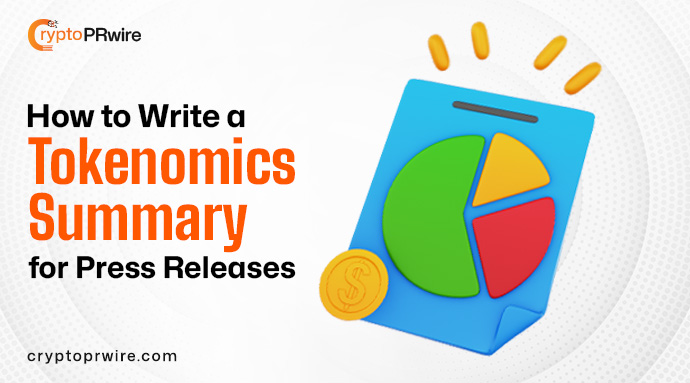
A full tokenomics document can run several pages with charts and vesting tables exactly the kind of detail a press release should never attempt to reproduce. The skill in tokenomics PR writing is compression: capturing the handful of facts that actually matter to a reader deciding whether to trust the project, without losing the nuance that makes those facts meaningful.
Readers scanning a press release rarely have the patience or context to parse a full tokenomics breakdown, but they do form a quick, often lasting impression based on whichever two or three numbers the release chooses to highlight. Getting that selection right matters as much as getting the underlying numbers themselves right.
The Five Numbers That Belong in Every Tokenomics Summary
A strong tokenomics summary should always include the following:
Total token supply, and whether it's fixed or subject to future minting
Allocation breakdown by category team, investors, community, treasury
Vesting schedule highlights for team and early investor allocations
Initial circulating supply at launch, distinct from total supply
Any burn or deflationary mechanism built into the token's design
These five points let a reader assess fairness and dilution risk without needing the full whitepaper, and they tend to be the exact details a skeptical crypto journalist or investor will look for first.
Presenting Allocation in a Way That Reads as Fair, Not Defensive
Rather than simply listing percentages, briefly explain the reasoning behind major allocations why the team allocation is locked for a given period, why community allocation is the size it is.
This framing pre-empts the skepticism that bare percentage lists often invite from crypto-savvy readers, who have learned to scrutinize allocation tables closely after years of projects with disproportionately large insider allocations.
Handling a Large Team or Investor Allocation Honestly
If team or early-investor allocation is larger than typical, address it directly with vesting and lock-up details rather than omitting it, astute readers and journalists will calculate this from on-chain data regardless, and a release that's silent on it looks evasive by comparison. A direct, confident explanation of why the allocation is structured the way it is tends to land far better than silence that invites readers to assume the worst.
Translating Vesting Schedules Into Plain Language
"24-month linear vesting with a 6-month cliff" is precise but easy to misread quickly. Pairing it with a plain-language gloss "no team tokens unlock for six months, then release gradually over two years" makes the commitment legible to a non-technical reader scanning the release.
This small addition costs almost nothing in space but meaningfully reduces the chance of the schedule being misunderstood or misreported.
Where Tokenomics Detail Belongs vs. Where It Doesn't
The press release should summarize; the full breakdown belongs on a dedicated tokenomics page linked from the release. Trying to cram complete vesting tables into the release itself overwhelms the news value and buries the actual announcement.
A short summary paired with a clear link to the full breakdown serves both the skimming reader and the more thorough one without forcing a tradeoff between brevity and completeness.
Updating Tokenomics Messaging as Circumstances Change
Tokenomics aren't always static after launch a governance vote might adjust emissions, or a treasury allocation might be redirected.
Any meaningful change to the originally announced token deserves its own clear communication, ideally before it takes effect rather than after, since retroactive explanations of a change that's already happened tend to generate far more suspicion than a transparent heads-up would have.
Anticipating the Questions a Skeptical Reader Will Ask
Experienced crypto PR tend to ask the same handful of questions when evaluating a new token structure: how much of the supply is controlled by insiders, how soon those insiders can sell, what mechanism (if any) supports long-term value beyond initial demand, and whether the stated allocation matches what's actually visible on-chain.
A tokenomics summary that proactively addresses these questions, even briefly, tends to generate fewer suspicious follow-up comments in crypto community channels than one that leaves readers to dig for the answers themselves through a block explorer.
Connecting the Summary to the Token's Broader Utility Story
A tokenomics summary reads as more coherent when it's clearly connected to the token's actual utility, rather than presented as an isolated set of numbers. If a meaningful share of supply is reserved for staking rewards, briefly note that connection; if community allocation funds an incentive program, say so directly.
This kind of cross-referencing helps a reader see the token as a deliberate, integrated design rather than a checklist of percentages assembled separately from the rest of the project's story.

Kartik Sharma is a content strategist and crypto PR writer specializing in blockchain, Web3, and digital marketing. With a passion for simplifying complex topics, he crafts SEO-driven content, press releases, and guides that help crypto startups gain visi