
- Home
- Crypto Blog
- How Infrastructure Projects Can Use PR to Attract Developers
How Infrastructure Projects Can Use PR to Attract Developers
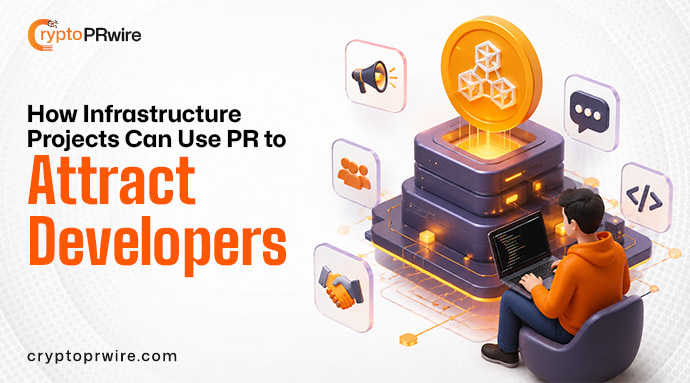
A blockchain infrastructure project needs developers to build apps, test tools, report issues, create integrations and bring users into the ecosystem.
However, developers may not discover a blockchain, Layer 2 network, node service, API, wallet toolkit oracle, bridge, data platform or developer framework on their own. The project must explain what it offers, why it matters and how builders can start using it.
This is where blockchain developer PR becomes useful.
Developer-focused public relations helps infrastructure projects share updates in a clear and trusted format. A planned press release can promote a testnet, mainnet, SDK, grant program, hackathon, API, integration or major protocol upgrade.
The goal is to help the right developers understand the opportunity and take the step.
What Is Blockchain Developer PR?
Blockchain developer PR is about sharing project updates with developers, technical media, Web3 communities, founders and ecosystem partners.
It combines press release writing, technical communication, developer relations, media outreach and community education.
A normal marketing campaign may focus on brand awareness or token activity. Blockchain developer PR focuses on questions that builders care about such as:
What can developers build with blockchain?
Which programming languages are supported?
Is the network live or still in testing?
Where are the technical documents?
Does the project offer an SDK or API?
Are grants, rewards or hackathons available?
How fast, secure or scalable is the infrastructure?
Where can developers ask for help?
Has the code been audited?
Is the project source?
Why Developers Matter to Infrastructure Projects
Infrastructure projects provide the base layer on which other products are built. Their long-term value often depends on how many useful applications, integrations, tools and services are created on top of them.
Developers can help an infrastructure project by:
1. Building decentralized applications
2. Creating wallets and analytics tools
3. Connecting services
4. Testing network performance
5. Finding bugs and security issues
6. Improving open-source code
7. Writing tutorials and sample projects
8. Bringing companies into the ecosystem
How Press Releases Support Developer Adoption
A press release creates a searchable record of an update. It can help developers, journalists, partners and community members find the verified information in one place.
Unlike a social media post a press release gives enough space to explain what has changed and why it matters.
Adoption Stages and PR Goals
Adoption Stage | Developer Question | PR Goal |
Awareness | What is this project about? | Introduce the infrastructure |
Interest | Why should I explore it? | Explain benefits. Use cases |
Evaluation | Can it support my app? | Share technical facts |
Activation | How do I start building? | Link to tools and documentation |
Retention | Will the project support me? | Promote updates and community help |
Advocacy | Can I contribute or teach others? | Highlight open-source |
Choose News That Developers Care About
Not every company update needs a developer-focused announcement. The strongest topics are those that create a building opportunity or remove a known technical problem.
blockchain developer PR topics include:
Mainnet or testnet launches
New SDK releases
API upgrades
Developer portal launches
contract tools
Cross-chain integrations
Node software updates
Open-source repositories
Developer grant programs
Hackathons and coding challenges
Build the Release Around a Real Use Case
A developer-focused press release should begin with the problem being solved.
For example a data infrastructure project should not announce a new API. It should explain how the API helps developers access blockchain data.
Include the Technical Details Developers Need
A blockchain developer PR campaign should provide technical detail to support evaluation.
Important information may include:
Supported blockchains
Programming languages
SDK versions
API access
Network status
Write a Clear Developer-Focused Headline
The headline should tell readers exactly what happened.
Strong Headline Formula
Project name + launches or updates + technical product + builder benefit
Make Documentation the Main Call to Action
The main call to action should lead to a resource, such as:
Developer documentation
GitHub repository
SDK download page
Promote Proof of Promises
Developers are more likely to test a platform when they can see evidence that it works.
Useful proof may include:
Number of developers
GitHub contributions
Completed integrations
Use Developer Quotes With Real Value
Quotes should add insight. They should not repeat the headline.
A useful quote, from a technology officer or engineering lead may explain:
Why was the update necessary
Which developer problem does it solve
What can builders create
How did feedback shape the product
What does the technical roadmap include
A developer partner may also explain how the infrastructure reduced the time it took to integrate or improved performance.
Avoid using quotes filled with terms like "game-changing " "groundbreaking," or "unmatched." These phrases do not add value unless they are supported by evidence.
Plan Internal Links for Users and Search Engines
links help readers move from educational content to useful service, pricing, publishing or research pages.
A good internal linking plan should:
Use anchor text
Link to relevant pages
Avoid repeating the anchor
Spread links naturally through the content
Keep links to the reader
Avoid adding links in one paragraph
For example, a reader comparing distribution options may benefit from a crypto media database that helps identify publications by category, language, authority, location and audience.
Internal links should support the reader’s question. They should never be added only to increase keyword use.
Time the Announcement Around Developer Activity
Timing affects whether an announcement creates action.
A press release should normally go live when developers can access the product or shortly before access opens. Publishing early may create interest that cannot be converted. Publishing late may reduce the value of the news.
A basic timeline may look like this:
Time | Recommended Action |
2–4 weeks before | Prepare technical facts and media list |
1–2 weeks before | Review links, claims, quotes and assets |
3–5 days before | Complete editorial and legal checks |
Launch day | Publish the release and community posts |
1–3 days after | Answer developer questions |
1–2 weeks after | Share tutorials, demos and early results |
Projects should also understand the expected crypto press release distribution timeline before setting a launch date or announcing a time-sensitive event.
Combine PR With Developer Relations
A press release can create awareness. It cannot replace developer support.
The strongest campaigns connect media coverage with a developer relations plan.
That plan may include:
1. Clear documentation
2. Live technical workshops
3. Office hours with engineers
4.. Bounties
5. Grant programs
6. Community support
7. Sample code
8. Product feedback sessions
9. Public roadmaps
10. Regular technical updates
Developer enablement should make it easy for a builder to move from interest to a working test. This requires onboarding, useful tools, reliable documentation and continued support.
Press coverage brings developers to the door. Developer relations help them enter, build and stay.
Measure the Results of Developer PR
Page views do not show whether a campaign attracted qualified builders.
Infrastructure projects should track actions taken after publication.
Metric | What It Shows |
Documentation visits | Interest in details |
SDK downloads | Early product evaluation |
API keys created | Developer activation |
First API calls | Successful onboarding |
Testnet wallets | Network testing activity |
GitHub forks | Interest in the code |
Pull requests | Active contribution |
Grant applications | Builder demand |
Hackathon sign-ups | Community growth |
Deployed apps | Real ecosystem adoption |
Developer retention | Long-term product value |
Use tagged links and campaign tracking to understand which media placements, articles and social posts send the most useful traffic.
The best metric is not how many people saw the press release. It is how many qualified developers took the next step.
Common Blockchain Developer PR Mistakes
Developer communication can fail when it is too promotional or does not provide practical information.
Common mistakes include:
Using a headline
Hiding the announcement
Making unsupported performance claims
Publishing before tools are ready
Linking to the homepage
Leaving out documentation
Using much technical jargon
Failing to name supported languages
Ignoring security and audit details
Giving no way to contact the developer team
Measuring impressions
Treating developers like token buyers
Projects should also avoid promises, guaranteed growth claims and token price predictions. These statements can create trust and compliance risks.
Blockchain Developer PR Checklist
Before publishing confirm that the press release includes:
A clear and factual headline
The primary announcement
A real developer problem
Supported networks and languages
Technical product details
Verified performance data
Documentation and GitHub links
A direct developer call to action
An technical quote
Security or audit information
Support and community channels
Correct contact details
internal links
Risk and limitation disclosures
A plan for measuring developer action
Every link should. Every product mentioned should be available according to the stated timeline.
Final Thoughts
Blockchain infrastructure grows when developers can understand it, test it and build products with it.
A strong blockchain developer PR strategy connects progress with clear public communication. It shows builders what changed, why it matters, how it works and where they can begin.
The effective press releases do not depend on hype. They provide facts, proof, documentation, useful links and a direct next step.
When press coverage is combined with tools, active support, open-source participation, grants and clear developer education infrastructure projects can turn a single announcement into lasting ecosystem growth.
Kartik Sharma is a content strategist and crypto PR writer specializing in blockchain, Web3, and digital marketing. With a passion for simplifying complex topics, he crafts SEO-driven content, press releases, and guides that help crypto startups gain visi