
- Home
- Crypto Blog
- How to Write a Crypto Press Release That Gets Picked Up
How to Write a Crypto Press Release That Gets Picked Up
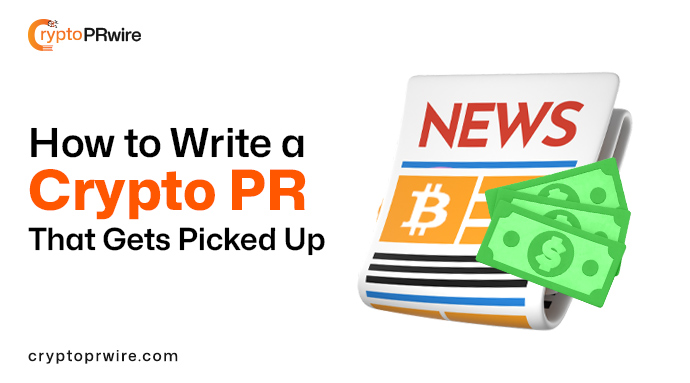
Getting a crypto press release picked up by journalists is harder than it looks. The Web3 space is flooded with projects pushing announcements, daily token launches, partnership deals, protocol upgrades, and roadmap milestones competing for a shrinking pool of editorial attention. Most press releases get ignored not because the project isn't newsworthy, but because the writing fails to meet basic journalistic standards.
This guide walks you through every step of crypto press release writing that actually earns coverage from structure and tone to distribution and timing.
Why Most Crypto Press Releases Fail
Before diving into what works, it's worth understanding what consistently fails. The majority of Web3 PR submissions share the same problems: vague, hype-filled headlines, buried leads, missing data, and an overabundance of insider jargon that means nothing to a general crypto reader, let alone a mainstream journalist.
Press releases for blockchain projects often read more like marketing copy than news. Editors at outlets like CoinDesk, Decrypt, or The Block receive hundreds of releases per week. They are looking for news something genuinely new, verifiable, and relevant to their audience. If your release reads like a sales pitch, it goes in the trash.
The fix starts at the structural level.
The Core Structure of a Strong Crypto Press Release
Every successful press release follows a clear, time-tested format. For crypto projects, that structure looks like this:
Headline : A single, direct sentence that communicates the core news. No superlatives, no "revolutionary," no "game-changing." Just the fact.
Dateline : City, Date. Standard practice. Don't skip it.
Lead Paragraph : The who, what, when, where, and why, compressed into two to three sentences. This is where you answer the journalist's first question: "What happened?"
Body Paragraphs : Context, background, data, and quotes. This is where you explain why this matters, how it works, and who is behind it.
Boilerplate : A standardized paragraph about your project. Every press release ends with one. Keep it factual and consistent across all releases.
Contact Information : A named PR contact with a real email address. Never leave this out.
Crafting a Headline That Gets Opened
Your headline is the single most important sentence in your release. Crypto journalists scroll through subject lines quickly. If yours doesn't immediately communicate something newsworthy, it won't get opened.
Avoid vague constructions like: "XYZ Protocol Announces Major Development in the DeFi Space"
That sentence says almost nothing. Instead, be specific: "XYZ Protocol Launches Automated Yield Optimizer with 120% APY on Ethereum Mainnet"
The second headline tells a journalist exactly what happened, what the mechanism is, what the number is, and where it lives. It's a real piece of news, not a promise of news.
Good headline formulas for crypto press release writing include:
[Project] Launches [Specific Feature/Product] on [Chain/Platform]
[Project] Raises $[Amount] in [Round Type] Led by [Investor Name]
[Project] Reaches [Metric] in [Timeframe], Surpassing [Benchmark]
[Project] Partners with [Named Partner] to [Specific Goal]
Notice that every formula contains a specific, verifiable fact. That's not accidental, it's what separates news from noise.
Writing the Lead Paragraph
The lead paragraph expands on the headline with the minimum context necessary to understand the story. In traditional journalism, this is called the "inverted pyramid" where you put the most important information first, then add detail.
For a blockchain project press release, your lead should answer these questions in order:
What happened? (The news itself)
Who is involved? (Project name, team or founder if relevant)
When did it happen or when does it go live?
What does it mean for users or the market?
Here's a weak lead: "XYZ Protocol is excited to announce that it has completed a major milestone in its development roadmap."
Here's a strong lead: "XYZ Protocol today launched its automated yield optimizer on Ethereum mainnet, enabling liquidity providers to earn compounding returns across 14 DeFi pools without manual rebalancing."
The strong version gives the journalist something to work with immediately.
Using Data and Specificity
Nothing makes a crypto press release more credible than hard numbers. Journalists need data points they can cite. Editors need facts they can verify. Readers need context to understand why something matters.
Whenever you make a claim in your release, back it up with a number. Instead of "significant growth," say "47% month-over-month growth in total value locked." Instead of "strong community," say "82,000 Discord members and 140,000 Twitter followers."
On-chain data is particularly powerful in this space because it's verifiable by anyone. If your protocol has $12M in TVL, link to the Dune Analytics dashboard or DeFiLlama page that shows it. This builds credibility with journalists who will independently verify before publishing.
The Role of Quotes
Every crypto press release should include at least one quote from a named person ideally the founder, CEO, or a relevant technical lead. The quote serves a specific purpose: it gives a journalist a human voice to include in their story without paraphrasing your messaging.
A strong quote is direct, opinionated, and adds context that the dry facts in the release can't provide. It should sound like something a real person would actually say.
Weak quote: "We are thrilled to announce this exciting milestone in our journey toward becoming the leading DeFi protocol."
Strong quote: "We built this optimizer because liquidity providers were leaving significant yield on the table by manually managing positions. This removes that friction entirely."
The second quote tells the reader something. It gives the journalist a line they can pull directly. It sounds human.
Timing Your Crypto Press Release
Even perfectly written Web3 PR tips won't help you if your timing is off. Crypto news cycles move fast. There are better and worse times to distribute.
Generally, Tuesday through Thursday mornings (US Eastern time) offer the best pickup rates. The weekend is a dead zone for editorial teams. Major market events, large price swings, protocol exploits elsewhere, regulatory announcements will drown out your news.
Monitor the news cycle before you distribute. If a major exchange has just announced an exploit, your token launch announcement will be invisible for 48 hours regardless of how well it's written.
Distribution: Where to Send Your Release
Writing a strong release is only half the battle. Crypto news distribution determines which outlets actually see it.
For most Web3 projects, a multi-channel distribution approach works best:
Tier 1 targets: CoinDesk, CoinTelegraph, Decrypt, The Block these require direct journalist pitches with a personalized angle, not just a wire submission.
Tier 2 targets: BeInCrypto, NewsBTC, CryptoSlate, AMBCrypto these publish more frequently and are more receptive to wire submissions.
Press release wire services: Platforms like CryptoPRWire distribute your release to hundreds of crypto and blockchain outlets simultaneously, building backlinks and syndication coverage even when direct editorial pitches are declined.
Your owned channels: Email newsletter, Discord announcements, Twitter/X threads always distribute through your own community alongside media outreach.
For most early-stage crypto projects, wire distribution plus two to three direct journalist pitches per release is the most cost-effective approach.
As you build relationships with specific journalists over time, your earned media rate improves dramatically.
Common Mistakes to Avoid
Burying the lead: If paragraph three is where your actual news lives, editors won't get there. Put the news in the first sentence.
No contact information: Journalists who want more information will move on if they can't reach a real person quickly.
Overpromising on token value: Any language that implies price appreciation is a regulatory red flag and will cause reputable journalists to reject your release.
Forgetting the boilerplate: A missing or inconsistent "About" section is an amateur signal. Write one strong paragraph and use it on every release. (For detailed guidance on this, see our article on How to Write a Boilerplate for Your Crypto Project.)
Ignoring SEO: Your Crypto press release will live online. Use your primary keyword naturally in the headline, first paragraph, and at least two more times in the body. For a deeper look at how this creates compounding value, see How Press Releases Build Long-Term SEO Value for Web3.
Building a Repeatable PR Process
The best crypto projects don't treat press releases as one-off events. They build a systematic, calendar-driven approach that keeps them consistently visible in the media.
This means planning releases around product milestones, community growth events, partnership announcements, and market cycles not scrambling to write something when there's news. A structured crypto PR calendar transforms your communications from reactive to strategic.
It also means building relationships with journalists over time, so that when you do have a major announcement, you have a shortlist of contacts who already know your project and trust your communications.
Final Checklist Before You Submit
Before sending your crypto press release to any outlet or wire service, run through this quick checklist:
Does the headline contain a specific, verifiable fact?
Does the lead paragraph answer who, what, when, where, and why?
Is there at least one quote from a named person?
Does the release include at least two data points?
Is there a boilerplate paragraph about the project?
Is there a named PR contact with a working email?
Has the release been proofread for typos and jargon?
Is the timing appropriate given current market news?
If all eight boxes are checked, your release is ready. If not, go back and fix the gaps. The difference between a release that gets picked up and one that gets ignored is almost always one of these fundamentals, not the size of the project or the significance of the news.

Kartik Sharma is a content strategist and crypto PR writer specializing in blockchain, Web3, and digital marketing. With a passion for simplifying complex topics, he crafts SEO-driven content, press releases, and guides that help crypto startups gain visi