
- Home
- Crypto Blog
- Crypto Press Release Approval Process Explained
Crypto Press Release Approval Process Explained
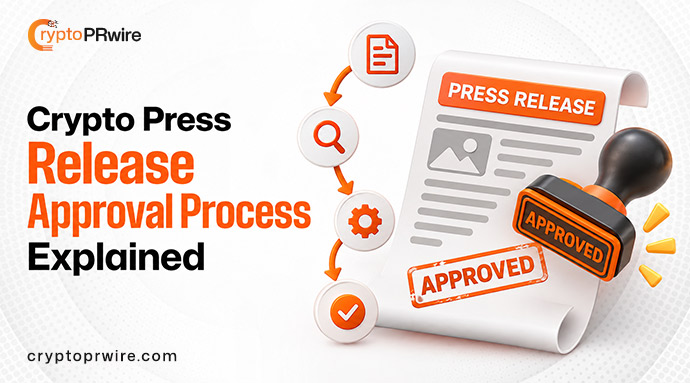
The Crypto Press Release Approval Process is more than checking grammar and spelling. A proper review looks at facts, sources, claims, links, disclosures, legal risks, and whether the release provides useful information to readers.
This matters because crypto announcements can involve tokens, exchanges, fundraising, partnerships, listings, blockchain products, and other financial topics. A weak claim can create confusion for readers and raise compliance concerns.
Google's news guidance also emphasizes transparency, including clear dates, bylines, author information, publisher details, and contact information.
For crypto publishers, a structured approval process can therefore help separate a useful announcement from promotional material that lacks enough evidence.
What the approval process checks first
When a press release arrives, the first step is usually a basic completeness check.
An editor needs enough information to understand who is making the announcement, what happened, and why the information matters.
Basic submission checks
A practical review normally checks:
Company or project name
Official website
Contact information
Release headline
Dateline
Announcement details
Executive or project quote
Supporting links
Images or media assets
Relevant disclosures
Source documents, where needed
Missing information does not always mean a release will be rejected. However, it can lead to questions or an editing request before publication.
For publishers handling crypto content, this first stage can prevent simple errors from moving into later editorial checks.
Why crypto releases need extra fact checks
Crypto content can contain claims about token supply, trading activity, partnerships, funding, exchange listings, technology, or regulatory status.
These claims should not be treated as facts simply because they appear in a submitted release.
For example, a project may state that it has formed a partnership with a major company. An editor can check whether the partner has made the same announcement through an official channel.
The same principle applies to exchange listings.
A statement that a token is "listed on" an exchange should be checked against the exchange's own announcement, asset page, or other reliable evidence when available.
The SEC has also published warnings about crypto-related fraud and misleading investment activity. In December 2025, the agency announced charges involving purported crypto trading platforms and investment clubs, alleging that more than $14 million was misappropriated from U.S. retail investors.
That does not mean every crypto press release is risky. It shows why verification matters when financial claims are involved.
Key approval process facts at a glance
Editorial approval checklist
Primary review: Accuracy, completeness, relevance
Financial claims: Require careful wording and evidence
Regulatory claims: Verify against official sources
Partnership claims: Check both parties when possible
Investment language: Avoid unsupported promises
Publisher transparency: Clear author, date, publisher, and contact details
Originality: Avoid copied or lightly rewritten material
Structured data: NewsArticle markup can help search engines understand article details
Google says Article structured data can help its systems understand information such as an article's headline, author, image, and publication dates. However, structured data itself is not a guarantee of Google News visibility.
Step one: Editorial screening of the release
The first real editorial stage is screening.
An editor looks at the overall purpose of the submission and asks whether it is genuinely newsworthy or simply promotional copy.
A useful release should clearly explain what happened.
For example:
Weak approach:
"Company X is the world's most exciting blockchain project."
Stronger approach:
"Company X announced the launch of its blockchain-based payment platform on September 16."
The second version gives readers a specific event that can be checked.
This distinction is important because Google News policies focus on useful, reliable news content rather than misleading presentation. Google also warns against content that misleads users through inaccurate previews or headlines.
Step two: Fact checking names, dates and numbers
The next stage checks factual information.
Editors may verify:
Company names
Executive names and titles
Launch dates
Token names and tickers
Blockchain networks
Token supply figures
Funding figures
Partnership details
Exchange names
Regulatory references
URLs
Product descriptions
Numbers deserve special attention.
A release might claim that a platform processed a certain trading volume or attracted a specific number of users. Such figures should be attributed to the company unless independent data confirms them.
For example:
"According to the company, the platform has processed X transactions."
This is different from presenting the number as an independently verified fact.
Clear attribution helps readers understand where information comes from.
Step three: Review financial and investment claims
Financial language is one of the most important parts of the approval process.
A crypto release should not present uncertain future outcomes as established facts.
Editors should flag language suggesting:
Guaranteed profits
Certain returns
Risk-free investment
Guaranteed token growth
Guaranteed exchange performance
Guaranteed market adoption
Guaranteed price increases
The SEC has repeatedly highlighted risks connected with crypto investment scams and misleading claims. Its investor alert explains that fraudsters can use crypto assets and online channels to attract retail investors.
Therefore, editorial teams should distinguish between a company's statement and an independently established fact.
For example:
Promotional:
"The token will deliver massive returns."
More responsible:
"The project says it expects the token to support its ecosystem, although future market performance remains uncertain."
That difference protects editorial clarity.
Step four: Check regulatory statements carefully
Regulatory claims require special attention.
A project might state that it is:
Registered
Licensed
Compliant
Approved
Regulated
Authorized
Those terms can have specific legal meanings.
An editor should not assume that a company's use of a regulatory term proves the underlying claim.
Where possible, the publication should check the relevant regulator or official filing.
For example, the U.S. SEC published an interpretation in March 2026 concerning the application of federal securities laws to certain crypto assets and transactions.
The broader lesson is simple: regulation can change, and a release should identify the jurisdiction and context behind a regulatory statement.
Step five: Verify partnerships and exchange claims
Partnership claims are common in blockchain announcements.
A release may announce a collaboration with:
A technology company
A crypto exchange
A payment provider
A blockchain network
A venture firm
A gaming company
A financial institution
The safest editorial approach is to look for confirmation from the other organization when the claim is material.
The same applies to exchange listings.
A publisher should avoid turning an expected listing into a completed listing.
For example:
Expected:
"The project announced plans to seek exchange listings."
Completed:
"The project announced that its token began trading on Exchange X."
Those are different events and should not be treated as interchangeable.
Step six: Review the headline and opening paragraph
The headline is one of the most important approval points.
A Google News-ready headline should describe the event clearly rather than exaggerate it.
Avoid headlines built around:
"Guaranteed"
"Huge Profit"
"Next Bitcoin"
"100x"
"Massive Returns"
"Risk-Free"
"Best Token Ever"
Instead, focus on the actual event.
Examples include:
"Blockchain Startup Announces New Payment Platform"
"Crypto Project Opens Public Testnet"
"Web3 Company Announces Strategic Partnership"
"Exchange Adds Support for New Digital Asset"
The first paragraph should then answer the basic questions:
Who? What? When? Where? Why does it matter?
This gives readers context before promotional details appear.
Step seven: Check quotes and executive statements
Quotes can add context, but they should be attributed correctly.
A company executive may discuss the project's goals, product strategy, or market plans.
The quote should not be rewritten in a way that changes its meaning.
Editors should also make sure the person quoted actually represents the company or organization named in the release.
For financial or market-related statements, attribution is particularly important.
Instead of writing:
"The market will grow rapidly."
A news report can write:
"The company's executive said the project expects demand to increase."
The second version makes it clear that the statement is an expectation rather than an established market fact.
Step eight: Check links, images and media assets
Links are another part of the approval process.
Editors should check whether links:
Work correctly
Lead to the claimed destination
Use secure HTTPS connections
Support the statement being made
Avoid deceptive redirects
Are relevant to readers
Images also need attention.
A featured image should represent the article accurately. It should not imply that a product, partnership, or event exists when the article does not support that claim.
For the article itself, a suitable image filename could be:
crypto-press-release-approval-process.jpg
Suggested featured image alt text:
Crypto Press Release Approval Process editorial review
Images should also be compressed and configured for efficient loading, especially on mobile pages.
How original content affects approval
Originality is another major editorial checkpoint.
Google News guidance says publishers should block scraped content and warns against reproducing another publisher's material with only minor changes.
That matters for crypto publications because the same announcement may appear across many websites.
A publication can still report on the same event, but its presentation should add genuine value.
That value can come from:
Original context
Clear attribution
Additional verification
Official documents
Relevant market data
Expert commentary
Timeline information
Comparison with previous announcements
Simply changing a few words from another article does not create strong original reporting.
What happens when a release needs edits?
Not every release that needs changes should be rejected.
In many editorial workflows, an editor sends questions or revision requests to the submitter.
Common requests include:
Provide a source for this figure.
Confirm the exchange listing date.
Clarify the regulatory statement.
Identify the person quoted.
Replace an unsupported claim.
Add the official company website.
Explain the partnership.
Correct the token supply figure.
Remove promotional language.
Add appropriate disclosure.
This stage can improve both accuracy and readability.
A useful approval process should therefore be viewed as a quality-control system, not simply as a yes-or-no publishing decision.
Why approval does not mean investment endorsement
Publishing a press release does not automatically mean that a publisher endorses the project, token, exchange, or investment opportunity.
This distinction is especially important in crypto.
An editorial approval process normally determines whether content meets the publisher's requirements for publication. It does not establish whether an asset will rise or fall in value.
The SEC's enforcement record shows why readers should distinguish published claims from independently verified financial facts. For example, the crypto press release agency has brought enforcement actions involving alleged fraudulent crypto offerings and platforms.
Readers should therefore conduct their own research before making financial decisions.
A practical crypto press release approval checklist
Before sending a release for review, use this checklist:
Content
Is the announcement specific?
Is the date correct?
Are names and titles accurate?
Are numbers supported?
Are quotes approved?
Compliance
Are financial claims properly qualified?
Are regulatory statements accurate?
Are investment promises removed?
Are sponsorships or commercial relationships disclosed where relevant?
Editorial quality
Is the headline factual?
Does the introduction explain the news?
Is the copy original?
Are promotional claims limited?
Are sources clearly attributed?
Technical quality
Do all links work?
Is the image relevant?
Is the image filename descriptive?
Is the alt text useful?
Are publication and modification dates available?
Internal publishing and distribution review
After editorial approval, the release can move toward publishing and distribution.
At this stage, the publisher may confirm:
Final headline
Final article body
Images
Links
Author information
Publication date
Category
Disclosure information
Structured data
Distribution settings
For publishers working with crypto and blockchain announcements, a clearly documented editorial process can also make it easier to handle repeated submissions.
A dedicated crypto press release submission process can help submitters understand what information editors need before review.
Publishers can also maintain crypto editorial guidelines so contributors know the expected standards before submitting material.
For broader distribution planning, readers can review information about crypto press release distribution and compare it with their specific publishing requirements.
Final outlook on crypto press release approval
The Crypto Press Release Approval Process works best when it combines editorial judgment, fact checking, source verification, compliance review, and technical checks.
The process is not simply about approving or rejecting a submission.
It is about determining whether readers can understand what happened, who made the claim, what evidence supports it, and which statements remain as expectations or projections.
For crypto publishers, this approach is particularly important because blockchain announcements can involve financial products, token markets, exchanges, and changing regulatory requirements.
A careful review cannot remove every risk from crypto publishing. However, it can make the difference between a release that simply promotes a project and one that gives readers clear, attributable, and useful information.

Kartik Sharma is a content strategist and crypto PR writer specializing in blockchain, Web3, and digital marketing. With a passion for simplifying complex topics, he crafts SEO-driven content, press releases, and guides that help crypto startups gain visi